
INDUSTRIAL BEARINGS
How to Choose the Right Industrial Bearings for Your Equipment
The core of selecting suitable industrial bearings for your equipment lies in matching the equipment’s operating conditions with the bearing’s performance. You can screen step by step according to the following key steps to ensure accurate adaptation:
Step 1: Clarify the Core Operating Condition Parameters of the Equipment (Most Critical Premise)
First, collect 3 core data points during the equipment’s operation, which directly determine the bearing type and specifications:
– Load type and magnitude: Determine whether the equipment is mainly subject to radial loads (e.g., motor shafts), axial loads (e.g., elevator traction machines), or combined loads (e.g., gearboxes) that include both; check if there are impact loads (e.g., mining machinery requires self-aligning roller bearings with impact resistance).
– Speed range: Distinguish between high-speed (e.g., motors, centrifugal pumps, which require deep groove ball/angular contact ball bearings with low friction) and low-speed & heavy-load (e.g., rolling mills, cranes, where plain bearings or tapered roller bearings are preferred).
– Operating environment: Confirm the temperature (use ordinary bearing steel for normal temperature, and ceramic/high-temperature alloy bearings for high temperatures ≥200°C), presence of corrosion (use stainless steel bearings for humid/chemical environments), and dust/foreign objects (enhanced sealing is required, such as bearings with rubber seals).
Request a Quote
Take the next step to forging your path to success. Request a quote from our team.
All Industries
Core Functions
- Friction Reduction and Energy Saving: Converts sliding friction into rolling friction (or fluid friction), significantly reducing energy consumption. - Precise Positioning: Fixes the radial/axial position of rotating parts, ensuring the accuracy of mechanical motion. - Load Transmission: Bears radial, axial, or combined forces during equipment operation, protecting core components.
Introduction to Industrial Bearings
Industrial bearings are core components of mechanical equipment. Their main function is to reduce the coefficient of friction of rotating or moving parts while supporting mechanical loads, ensuring efficient and stable operation of the equipment.
Covering almost all industrial scenarios, such as motors, machine tools, automotive chassis, wind power equipment, mining machinery, robot joints, etc.
Thrust roller bearings
A thrust roller bearing is a type of bearing that uses rollers as rolling elements and is specifically designed to withstand high-intensity pure thrust (axial) loads.
Tapered Roller Bearings
Tapered roller bearings are a type of bearing that uses tapered rollers and can simultaneously withstand high-intensity radial loads and unidirectional axial (thrust) loads.
Self-aligning Roller Bearings
Self-aligning roller bearings are a type of bearing that uses drum-shaped rollers, has high load capacity (radial and bidirectional axial), and can automatically adjust and compensate for slight misalignment of the shaft or bearing housing.
Cylindrical Roller Bearings
Cylindrical roller bearings are a type of bearing that uses cylindrical rollers and has extremely high radial load capacity, but cannot or can only withstand very small axial loads.
Thrust ball bearing
A thrust ball bearing is a type of bearing that uses steel balls as rolling elements and is specifically designed to withstand unidirectional or bidirectional pure axial (thrust) loads, but cannot withstand radial loads.
Angular contact bearings
An angular contact ball bearing is a type of bearing whose raceways are offset from each other along the axial direction, enabling it to simultaneously withstand radial loads and unidirectional (or bidirectional) axial loads when paired.
Self-aligning ball bearings
Self-aligning ball bearings are a type of bearing with two rows of steel balls and an outer ring spherical raceway. They can automatically compensate for angular misalignment or misalignment between the shaft and the bearing housing, and are suitable for high-speed bearings.
Deep groove ball bearings
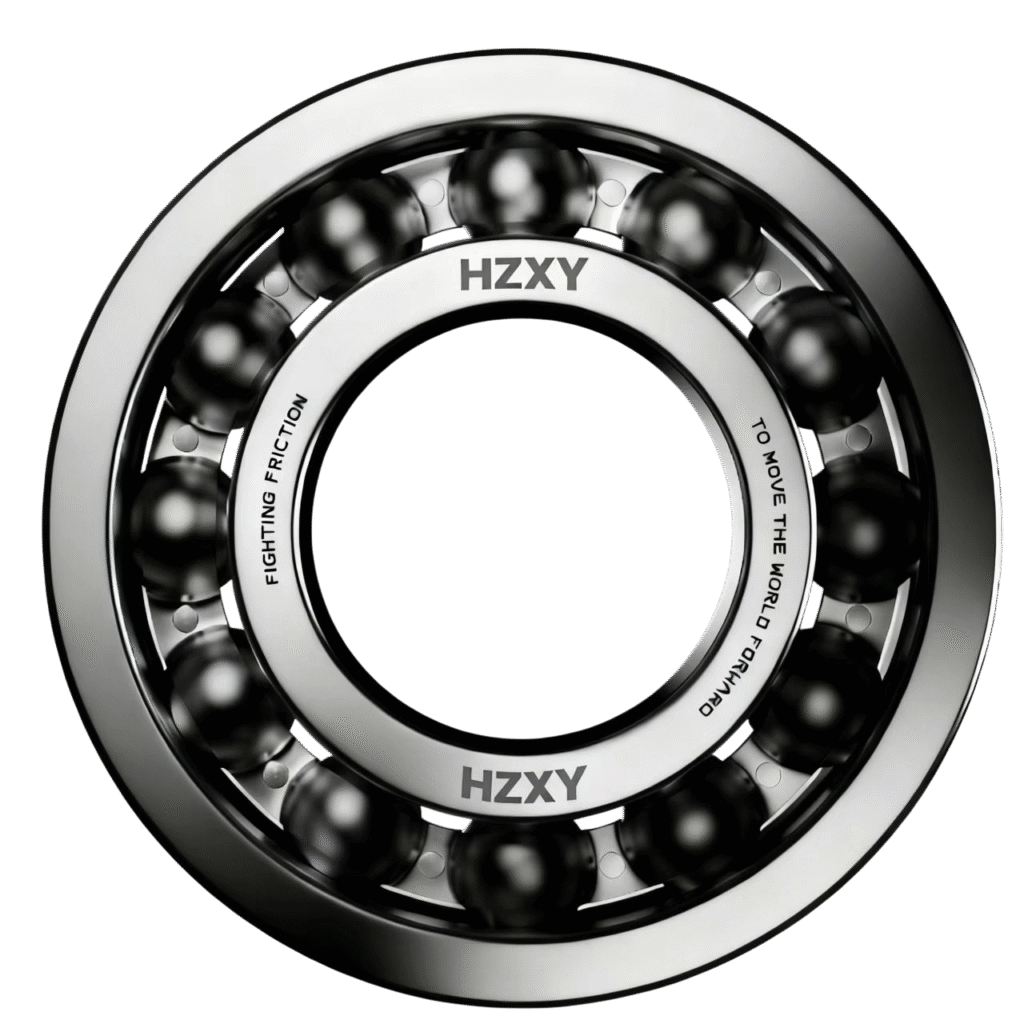
Deep groove ball bearings are one of the most widely used rolling bearings. The raceways and steel balls have an excellent fit, enabling them to withstand radial loads and bidirectional axial loads, and they are suitable for high-speed operation.
Key Parameters
- Precision Class: Determines rotational accuracy. Commonly P0 (ordinary) to P2 (high precision). Machine tools and precision instruments require higher precision classes. - Speed Range: Limited by materials and lubrication. High-speed equipment (e.g., motors) requires bearings that are resistant to high temperatures and have low friction. - Load Class: Rated dynamic/static load. Must match the actual stress conditions of the equipment to avoid overload damage.
Our Standard Bearing Timeline
Scroll through to learn more about how our forging manufacturing process works:
Step 1/7
SolidWorks 3-D Modelling & Closed-Die Concept
LungChau Forge engineers turn your finished or semi-finished drawing into a validated 3-D SolidWorks model and multi-directional die layout within days.
Step 2/7
Die-Steel Machining on CNC Centres
We purchase premium die steel and machine the upper, lower and side rams to micron tolerances in our own machining centre.
Step 3/7
Certified Material Procurement
Alloys are ordered to the exact grade and size jointly signed off on the billet drawing, with full mill test certificates.
Step 4/7
Incoming Inspection & Precision Cutting
Bars are verified, then bandsaw or sheared into weight-controlled billets ready for heating.
Step 5/7
Green Heating – Induction or Natural-Gas Furnace
Billets are heated uniformly in an eco-friendly natural-gas or medium-frequency induction furnace to the optimal forging window.
Step 6/7
Multi-Ram Closed-Die Forging
Hot billets are shuttled within seconds to friction-screw or hydraulic presses where multi-directional rams form complex net-shape parts in one strike.
Step 7/7
UT / MT Non-Destructive Testing & Release
Every lot can be ultrasonically or magnetic-particle inspected to ASTM, EN or customer standards, ensuring defect-free delivery from LungChau Forge.